myAir™ by Resmed
- 4.2
- Rating
- 1.00M
- Installs
- Free
- Price

 Analysis by App-foxy
I approached myAir™ as a companion for people using positive airway pressure therapy, rather than as a general sleep tracker. That distinction matters. This is a free medical app from Resmed, designed to help users start and stay engaged with PAP treatment. In my experience, its value comes less from offering another place to look at sleep data and more from turning therapy into a routine that feels easier to understand.
The app is aimed at people who use compatible Resmed PAP equipment and want support between appointments. It is not a replacement for a clinician, a diagnostic tool, or a cure for sleep-related breathing problems. I found it most useful when I treated it as a daily check-in: a way to notice how therapy is going, identify recurring friction, and arrive at a medical conversation with clearer observations.
That makes the audience fairly specific. If you have just received a PAP machine and feel overwhelmed by the first few nights, myAir can make the process feel more guided. If you already manage therapy confidently and never look at trends or coaching, the app may add little. Its usefulness depends heavily on whether you want an ongoing digital companion, not simply whether you own a phone.
You May Also Like

 Blood Strike: 2.5 Anniversary
Blood Strike’s Loadouts Turn Every Drop Into a Tactical Gamble
A close look at Blood Strike’s custom loadouts: how fast access to signature weapons reshapes its battle royale rhythm, rewards preparation, and narrows the gap between fights.

 Pandora - Music & Podcasts
Pandora’s Music Is Easy to Start, but Harder to Recover
Pandora’s strength is its low-effort path from a seed to a station. Its weak spot is how much confidence it asks you to place in connection, setup, and quiet recovery.

 8 Ball Pool
 Is Built on Rivalries, Rematches, and Routine
A close look at the rivalries, rematches, shared routines, and unanswered safety questions that turn a quick pool match into a persistent mobile community.

 Samsung Music
’s Quiet Strength Is Playing What You Already Own
Its reach comes less from spectacle than from dependable access to a personal library. That simplicity is both the app’s strongest retention engine and its ceiling.

 AccuWeather: Weather Radar
AccuWeather Review: A Quick, Clear Forecast for Everyday Decisions
For everyday plans, the best forecast is the one you can understand quickly. AccuWeather makes rain timing, radar, and local conditions easy to act on, with a few trade-offs.

 Hill Climb Racing
Why Hill Climb Racing Still Turns Crashes Into One More Run
A tiny car, a bumpy hill and one more upgrade: Hill Climb Racing keeps resurfacing because its simple chaos makes every near-miss feel personal.
More From Our News Desk



How myAir fits into everyday PAP therapy
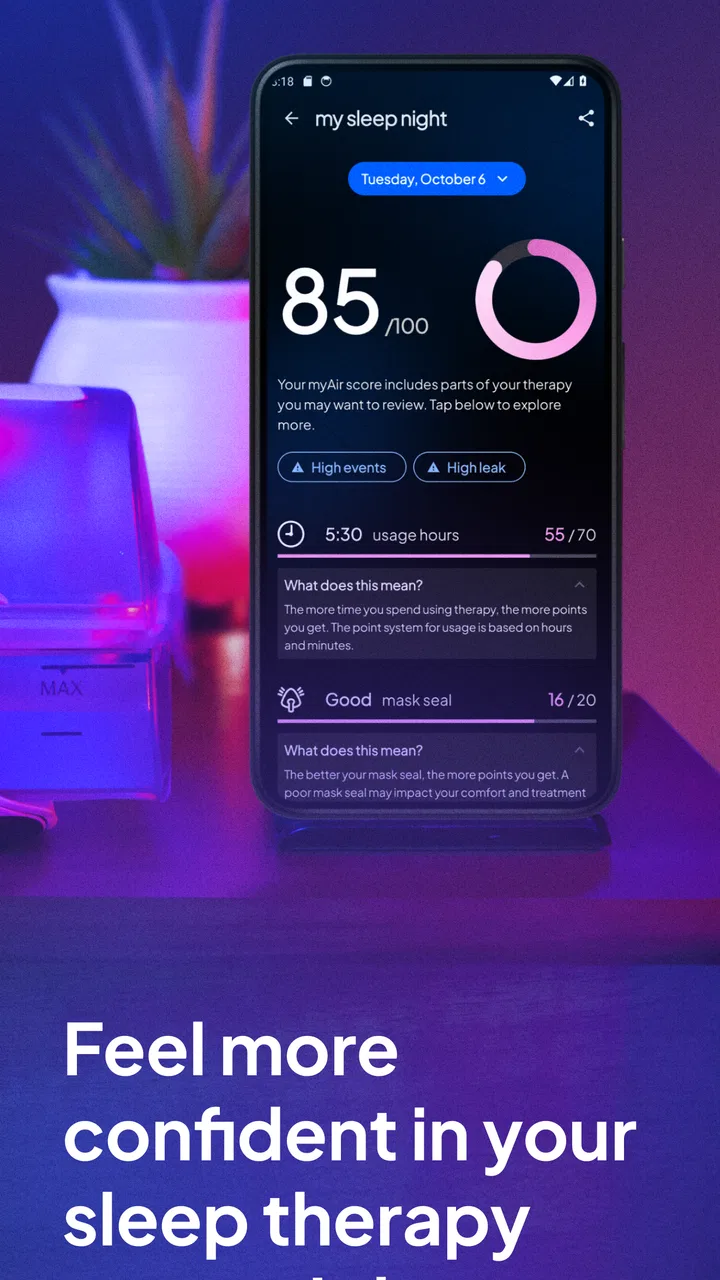
The current experience is built around making treatment easier to follow. Instead of asking users to interpret every technical detail, the app presents therapy information in a more approachable format. I liked that general direction because PAP treatment can feel demanding at first: there is equipment to set up, a mask to adjust, and a new bedtime habit to establish.
A realistic example is someone who wakes after a restless night and immediately wonders whether the treatment worked. Without any structure, that uncertainty can lead to guesswork or even abandoning the mask. With myAir, the user has a dedicated place to review the night and continue building familiarity with the routine. The app does not remove the discomfort of adaptation, but it can make the experience feel less isolated.
For a new user, I would use it at a consistent time each morning rather than repeatedly checking throughout the day. A quick review after waking is enough to notice whether the night felt typical, whether the equipment caused trouble, and whether the overall pattern is improving. Looking too often can turn therapy into a source of anxiety, especially when a single night is treated as a verdict.
One of the app’s strongest practical qualities is its focus on continuity. PAP therapy is not usually judged by one successful night. The more useful question is whether the user can keep using it while dealing with ordinary problems such as an awkward mask, dryness, interrupted sleep, or uncertainty about progress. A tool that encourages regular attention can be more helpful than a technically richer dashboard that most people ignore.
I would still keep expectations realistic. The app cannot make an incorrectly fitted mask comfortable by itself, and it cannot decide whether a treatment setting is appropriate. If discomfort persists, the right next step is a clinician or equipment provider. The app is best used to support that conversation, not to replace it.
What the app does well for beginners
The most valuable feature, in my view, is the way myAir gives a new user a sense of sequence. PAP treatment can otherwise seem like a collection of disconnected tasks. The app helps frame it as a process: use the equipment, review how the night went, learn from recurring issues, and keep going.
That structure is especially helpful for people who respond well to visible progress. A person who feels discouraged after a poor first night may benefit from seeing the experience as part of an adjustment period rather than as proof that PAP will never work. I found this more encouraging than relying on memory, which tends to exaggerate the worst night and forget gradual improvement.
Another useful insight is that the app can help separate a therapy problem from a sleep problem. If a user wakes tired, the immediate conclusion may be that the machine failed. A broader look at several nights can encourage more careful thinking. Perhaps the issue is inconsistent use, mask discomfort, or simply an unusually bad night. That distinction is important because changing equipment or settings based on one morning can create more confusion.
For someone helping a family member, myAir can also provide a shared vocabulary for discussions with a clinician, even though the user remains responsible for deciding what to share. Saying “the mask feels uncomfortable on most nights” is more useful than saying “the machine is not working.” The app’s role is not to diagnose the cause, but to make observations easier to organize.
How experienced users may use it differently
Long-term PAP users may not need encouragement to put on the mask, but they can still use myAir as a lightweight record of consistency. I would not recommend opening it simply out of habit if the information does not change anything you do. Instead, experienced users can use it when a pattern changes: after replacing equipment, during travel, after a period of poor sleep, or when therapy begins to feel less comfortable.
This is where the app compares favorably with a paper note or a basic phone reminder. A notebook can record whether the mask was used, but it does not create the same therapy-centered routine. A generic sleep application may show bedtime, wake time, or movement, yet it usually cannot serve as a focused companion for PAP use. On the other hand, specialist software used by clinicians may offer deeper technical analysis, so myAir should not be mistaken for the most advanced review tool available.
The trade-off is simplicity. I prefer myAir for daily orientation, but I would choose a more clinical workflow when the question involves detailed treatment evaluation. Someone who wants to study every technical aspect of therapy may find the app intentionally limited. That is not necessarily a flaw; it is a reminder that the product is designed for everyday engagement rather than professional-level investigation.
An experienced user can also avoid a common mistake: treating the app’s feedback as a score to chase. The goal is effective, sustainable treatment, not a perfect-looking screen. If the app encourages you to notice a recurring issue and ask the right question, it is doing its job. If it makes you obsess over nightly variation, it is being used in the wrong way.
Development and the product’s current maturity
Resmed released myAir on April 17, 2018, and the app has had time to establish itself as a recognizable part of the company’s digital experience. Its current position feels more like a mature companion than an experimental utility. That matters for people who want a product with a clear purpose instead of a collection of unrelated wellness tools.
The app runs on Android starting with version 9, which makes it accessible to many users without requiring a very recent phone. I still recommend checking the device experience before relying on it for an important routine, because compatibility with the phone is only one part of the picture. The PAP equipment and the way the app receives or presents therapy information are equally relevant to whether it will be useful for you.
Its reach also suggests that this is not an obscure side project. myAir has more than a million installs, with an average rating of 4.1 from roughly thirty-five thousand ratings and about eleven thousand written reviews. Those figures do not guarantee that every user will have the same experience, but they do show that the app has a substantial audience and enough public feedback to reveal both its appeal and its friction points.
I would describe the evolution as a move toward making PAP support less intimidating for ordinary users. The important change is not a single flashy addition; it is the continued emphasis on helping people engage with treatment outside the clinic. That direction suits the problem. PAP success often depends on small, repeated behaviors, and an app can be useful when it reinforces those behaviors without pretending to be medical care.
For existing users, this maturity has a practical effect: there is less need to reinvent a personal tracking system. If your current method is a note on the bedside table or a generic reminder, myAir may give you a more relevant place to review your routine. However, changing systems is not automatically worthwhile. If your present method already helps you use therapy consistently and communicate clearly with your clinician, the app should earn its place rather than being adopted simply because it is available.
Where the experience still has friction
The first limitation is that myAir is not equally valuable to every PAP user. Its usefulness depends on a compatible Resmed setup and on the user being comfortable with a connected digital routine. Someone who uses different equipment, prefers not to track therapy digitally, or has limited access to a suitable phone may be better served by direct clinical follow-up and a simple written log.
The second limitation is emotional. Daily feedback can motivate one person and unsettle another. New users may read too much into a disappointing night, while experienced users may become overly focused on small changes. I would advise using the app to identify trends and questions, not to make immediate treatment decisions. A single result should rarely outweigh how the therapy behaves across time and what a qualified professional advises.
There is also a difference between information and explanation. Seeing that a night was difficult does not automatically reveal why. The cause might involve mask fit, sleeping position, congestion, equipment handling, or something unrelated to the machine. The app can help you notice the problem, but it cannot provide the full clinical context needed to solve every problem.
Another trade-off is that a focused medical companion may feel narrow compared with broad sleep apps. If you want meditation libraries, lifestyle coaching, smart alarms, or a wide range of wellness experiments, myAir is not the obvious choice. Its narrower purpose is actually a strength for PAP users, but it will feel restrictive to someone looking for an all-purpose sleep platform.
I would also avoid expecting the app to replace appointments. A digital record can make a consultation more efficient, but it cannot perform a physical assessment, inspect equipment, or understand your complete medical history. The best workflow is to use myAir as preparation: note recurring concerns, describe how they affect your sleep, and bring those points to the appropriate professional.
Practical habits that make it more useful
My first tip is to establish a short morning routine around it. Review the night once, record any relevant discomfort in your own words, and then move on with the day. This prevents the app from becoming a constant source of reassurance-seeking while still preserving useful awareness.
My second tip is to pair app observations with real-world context. If a night looks different, remember whether you travelled, slept in a new position, had a blocked nose, changed the mask setup, or went to bed unusually late. The app becomes much more informative when its feedback is connected to what actually happened in your life.
Third, use repeated patterns to decide when to ask for help. A recurring issue deserves more attention than an isolated poor night. This is a subtle but important workflow: myAir can be the place where you notice repetition, while your clinician remains the person who interprets it and recommends changes.
Fourth, do not confuse engagement with success. Opening the app every morning is not the same as using PAP effectively, and a polished progress view should not pressure you into ignoring discomfort. If the mask causes persistent problems or therapy feels unmanageable, seeking practical assistance is more valuable than trying to maintain an unbroken digital routine.
Finally, give the app a fair trial without making it a permanent obligation. After several weeks, ask yourself whether it helps you understand therapy, maintain consistency, or communicate better with your care team. If the answer is no, a simpler approach may suit you better. Digital support should reduce effort, not add another task to an already tiring bedtime routine.
Who should choose it, and who should skip it
I would recommend myAir to a new Resmed PAP user who wants gentle structure during the adjustment period. It is also a sensible choice for someone who likes reviewing patterns, benefits from reminders of progress, or wants a dedicated place to prepare questions for a clinician. The fact that it is free removes one common barrier to trying it, although the real value still depends on equipment compatibility and personal habits.
I would be more cautious about recommending it to someone who becomes anxious when checking health information. That person may benefit from limiting reviews to a planned schedule or relying on clinician-led follow-up instead. I would also steer away from it for users seeking diagnosis, detailed medical interpretation, or a complete sleep laboratory replacement. Those are different needs.
People who use another brand of PAP equipment should not assume that a Resmed-focused companion will be the best fit. A manufacturer-neutral log, a clinician’s preferred platform, or a tool designed for their own device may be more practical. Likewise, users who want an expansive lifestyle sleep app should compare the focus carefully before installing it.
The strongest case for myAir is not that it contains everything. It is that it concentrates on one difficult job: helping people stay engaged with PAP therapy. In my experience, that focused approach is more useful than a broad collection of sleep features when the main challenge is simply making treatment part of normal life.
What I would watch as a user
When deciding whether to keep using the app, I would watch for three things. First, does it help you notice meaningful patterns rather than isolated fluctuations? Second, does it make conversations with your clinician clearer? Third, does it support consistent treatment without increasing worry? Those questions are more important than how attractive the interface feels.
I would also pay attention to how well the app fits changes in your routine. Travel, equipment adjustments, illness, and changes in sleep schedule can all affect how useful a daily companion feels. A good tool should remain understandable during those disruptions, but the user should still interpret unusual periods carefully rather than comparing them directly with ordinary nights.
For existing users, future value will depend on whether Resmed continues to balance guidance with restraint. More information is not automatically better. The most helpful evolution would preserve clear explanations, keep the daily workflow manageable, and make it easier to turn recurring observations into productive clinical questions. Anything that encourages self-adjustment without professional input would be a poor trade.
My final view is positive but deliberately measured. myAir™ is a practical PAP companion, not a medical authority. It is free, available for Android from version 9 onward, rated for Everyone, and developed by Resmed for a clearly defined need. I would recommend it to compatible users who want support building a sustainable routine, especially during the early weeks of treatment.
I would not install it expecting a diagnosis, a replacement for appointments, or a complete sleep-tracking ecosystem. Its best use is quieter and more practical: check in, notice patterns, connect those patterns with everyday circumstances, and ask better questions when something keeps going wrong. Used that way, myAir™ can make PAP therapy feel more manageable without pretending that an app can do the work of proper medical care.
FAQs for myAir™ by Resmed
01What is myAir™ by Resmed used for?
myAir™ by Resmed is designed for users of Resmed CPAP machines. It helps track sleep therapy progress by providing personalized feedback, detailed reports, and helpful tips to improve sleep quality. The app is particularly beneficial for users who want to understand their sleep patterns and enhance their therapy adherence.
02Is myAir™ compatible with all CPAP machines?
myAir™ is specifically compatible with Resmed AirSense™ 10 and AirCurve™ 10 devices. If you're using a different model or brand, the app may not support your machine. Ensure your CPAP device is compatible before downloading to make full use of the app’s features.
03How does myAir™ track my sleep therapy?
myAir™ tracks sleep therapy by connecting wirelessly to your Resmed CPAP machine. It gathers data on usage hours, mask seal, events per hour, and mask on/off events. This information is then presented in an easy-to-understand format, helping users monitor their therapy progress over time.
04Is my personal data secure in the myAir™ app?
Yes, Resmed prioritizes user privacy and data security. The myAir™ app uses encryption and secure servers to protect your personal and therapy data. Users are encouraged to review the app’s privacy policy to fully understand how their data is managed and safeguarded.
05Can I use myAir™ without an internet connection?
While you can view previously synced data offline, myAir™ requires an internet connection to sync new data from your CPAP device. To receive the most accurate and up-to-date insights and reports, ensure your device is connected to Wi-Fi or mobile data regularly.
Pros
- User-friendly interface enhances usability.
- Detailed sleep analysis and reports.
- Personalized tips for better sleep.
- Seamless integration with ResMed devices.
- Tracks sleep trends over time.
Cons
- Limited compatibility with non-ResMed devices.
- Requires stable internet connection.
- Some features need subscription.
- Battery consumption is relatively high.
- Initial setup can be time-consuming.

myAir™ by Resmed
Gallery